Why Timing Matters More Than It Seems
Central air in Rome doesn’t get asked to work very often. Most years, genuinely hot stretches add up to a handful of weeks, not months, which means a system that’s already struggling can go unnoticed right up until the one week it actually has to perform. There’s no slack built into a season this short: if your AC fails in late July, that’s not a “get to it eventually” problem. It’s failing during the exact stretch the whole point of having it comes due.
What’s Actually Wrong When Your AC…
Runs, but doesn’t cool the house.
Usually one of three things: refrigerant has leaked out and the system can’t absorb heat properly anymore, the outdoor condenser coil is caked with grass clippings and cottonwood fluff and can’t shed heat, or the compressor itself is weakening. We check all three before assuming it’s the expensive one.
Won’t turn on at all.
Often electrical, not mechanical, a tripped breaker, a blown low-voltage fuse, a failed capacitor that can’t give the compressor and fan motor the jolt they need to start, or a thermostat that’s lost communication with the system. A “dead” system is usually a small part that stopped a big one from starting.
Blows warm air.
If the outdoor unit isn’t running at all while the indoor blower is, that points electrical or refrigerant-side, not airflow. If both units are running and the air still isn’t cold, that’s more often a refrigerant charge issue or a compressor genuinely giving out.
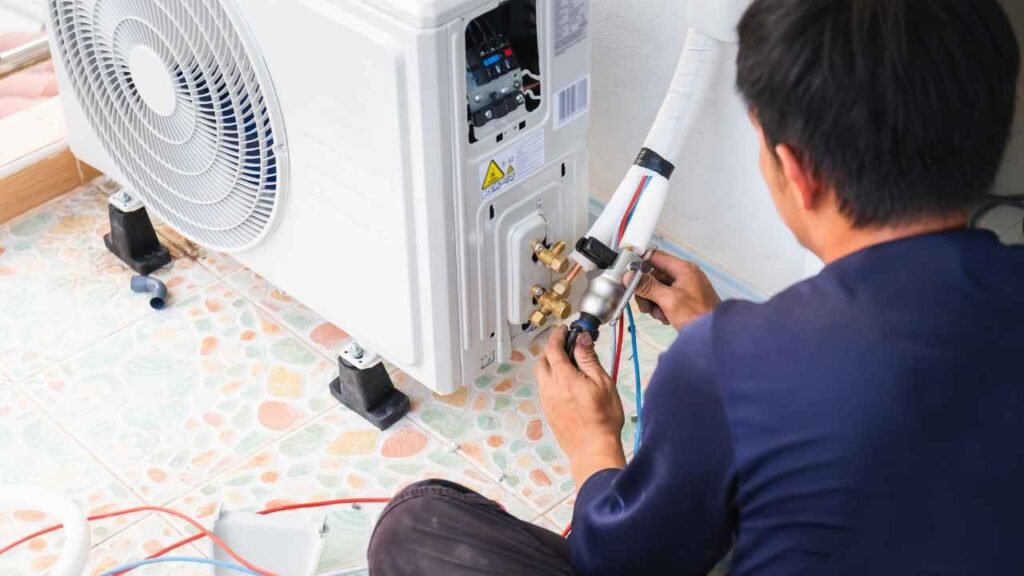
Builds up ice on the unit or the copper lines.
Airflow restriction, most often: a dirty filter, a blocked return, low refrigerant, or a failing blower motor all starve the coil of the airflow it needs, and it responds by freezing over instead of cooling. Running the system harder to compensate makes the ice worse, not better.
Leaves water pooling near the indoor unit.
Almost always a clogged condensate drain line, algae and dust build up in that line the same way any drain does, and it backs up. Caught early, it’s a five-minute fix. Missed, it’s a moisture problem in your house.
Short-cycles — on and off every few minutes.
Sometimes electrical, sometimes a dirty coil overheating the compressor, and sometimes a system that was oversized for the house to begin with and was never going to run in long, efficient cycles regardless.
Keeps tripping the breaker.
Don’t keep resetting it and hoping the next one holds. A breaker that trips more than once is telling you something, usually a failing compressor drawing more current than it should, or a genuine electrical fault, and it’s worth a prompt look rather than a third reset.
Ductless & Mini-Split Repair
Ductless systems fail differently than central air in a few specific ways worth knowing:
- Blinking or flashing lights on the indoor unit — most ductless brands use these to display a fault code rather than a plain warning light; the pattern usually points to the problem before we even open the unit.
- Water leaking from the indoor head — ductless systems typically rely on a small condensate pump rather than gravity drainage, and that pump is a common failure point, especially in rooms without a nearby drain.
- One zone not cooling while others work fine — usually isolated to that indoor unit’s coil, fan, or line set, not the outdoor condenser serving the whole system.
- Indoor and outdoor units not communicating — shows up as the indoor unit running while the outdoor compressor never kicks on; often a control board or wiring issue between the two.
We diagnose ductless mini-splits the same way we do central air, check first, replace parts second, including the units going into more Rome-area additions and garages every year.
AC Repair, or Time to Replace?
If your system runs on R-410A, which covers most units installed over the last decade or so, a refrigerant leak is worth a second look before we just top it back off. R-410A is being phased down under federal regulation (the EPA’s AIM Act), and while existing systems remain completely legal to service indefinitely, wholesale refrigerant costs have already climbed well past where they sat a few years ago and are expected to keep climbing as supply tightens further.
Repair usually makes sense when:
- The leak is small and a one-time event, not slow and recurring
- The system is roughly under 10–12 years old
- The failed part is isolated, a capacitor, contactor, or fan motor, rather than the compressor itself
Replacement starts to make more financial sense when:
- The refrigerant leak is recurring, or the coil itself is failing
- The compressor has failed on a system already past 10–12 years old
- Repair costs start approaching a meaningful share of what a new system would cost
That’s a conversation we’ll actually have with you, not skip past on the way to a bigger invoice. If replacement turns out to be the right call, we also provide ac installation and replacement services in Rome, NY.
Refrigerant work itself isn’t something to hand off to a store-bought recharge kit, either, handling it legally requires EPA Section 608 certification, full stop.
What a Repair Visit Actually Looks Like
We check electrical, refrigerant charge, and airflow together on the first visit rather than replacing the first suspicious part and hoping. A lot of AC symptoms overlap, a failing capacitor and a low refrigerant charge can both show up as “it runs, but it’s not cold enough”, and guessing wrong just turns into a second visit and a second bill.
You’ll get a clear price before any repair work starts, not after, and the repair itself is backed our workmanship warranty terms.
When It Can’t Wait
AC failure isn’t the same kind of emergency a dead furnace is in a Rome January, nobody’s pipes freeze because the air conditioner quit. But it matters more than “eventually” in a house with small kids, older residents, or anyone with a heat-sensitive health condition, especially during an actual heat stretch. We’re available 24 hours a day for exactly those calls.
Serving Rome, NY and Nearby Towns
We repair central air and ductless systems throughout Rome (13440) and the surrounding area, Westmoreland, Verona, Floyd, Camden, Oriskany, and Whitesboro.
Questions We Get on Repair Calls
Why is my AC blowing warm air?
Most often a refrigerant issue or the outdoor unit not running at all while the indoor blower keeps going, both point away from a simple fix like a thermostat setting.
Is it normal for ice to form on my air conditioner?
No, ice means airflow is restricted somewhere in the system. Turning it off to let the ice melt won’t fix the underlying cause; it just delays finding it.
How much does it cost to add refrigerant?
It depends on the refrigerant type and how much the system is low, but it’s worth knowing upfront that R-410A costs have risen substantially as federal phasedown rules tighten supply, which is exactly why we check for a leak instead of just recharging and sending you on your way.
My breaker keeps tripping. Is that actually a problem?
Yes, treat a repeat trip as a real fault, not a fluke. It’s usually electrical or a struggling compressor, and it’s worth a same-week look rather than several resets.
How fast can you get someone out?
We’re available 24 hours a day, and during an active heat stretch, calls get prioritized by real urgency, a house with no cooling and a vulnerable resident moves ahead of a routine check-up. Call and we’ll give you a straight answer on timing for your specific situation, rather than a generic promise that might not hold on the busiest days of summer.